
Back to Blog Index
Introducing Color Background Sequential Barcodes and QR Codes
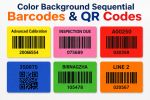
We are excited to introduce our new color background sequential barcodes and QR codes, sometimes referred to as floodcoat labels. These labels combine bold, easy-to-see background colors with sequential numbering and barcode or QR code functionality, giving customers a labeling solution that is both highly practical and visually effective.
For many businesses, labels do more than identify an item. They help organize processes, separate categories, speed up handling, reduce mistakes, and make tracking easier. By adding a bright background color to sequential barcode and QR code labels, companies can create a simple visual system that helps employees recognize important differences at a glance while still maintaining the accuracy of scan-based tracking.
Our color background labels are available in barcode-scannable colors such as Pantone Yellow, 176 Pink, 032 Red, 290 Blue, 345 Green, and 1495 Orange, making it easier to assign meaning to color while preserving reliable readability.
Why Color-Coded Sequential Labels Matter
Standard sequential barcode and QR code labels are already a powerful tool for identification and tracking. Adding a solid background color makes them even more useful. Color creates instant visual recognition. Instead of stopping to read every label, users can often sort, route, or identify items by color first and then confirm with the printed number, barcode, or QR code.
This can be especially valuable in fast-moving environments such as warehouses, manufacturing facilities, stockrooms, schools, laboratories, medical offices, file rooms, and shipping departments. A bold color background helps the label stand out while giving the user one more layer of useful information.
These labels are ideal for organizations that want to improve workflow, reduce handling errors, and make their numbering systems easier to use in the real world.
What Makes These Labels Useful
A color background sequential barcode or QR code label can provide several benefits in one small format. Each label can be designed to include:
- a unique sequential number
- a barcode or QR code
- a solid background color
- optional prefixes, suffixes, logos, or custom text
- duplicate or triplicate numbering if needed
This means the same label can support both human-readable identification and fast electronic scanning. Employees can quickly recognize the label visually, while systems can capture the data accurately through the barcode or QR code.
Practical Ideas for Using Color Background Labels
One of the best things about color background sequential labels is their flexibility. Different businesses can use the same basic label format in very different ways. Here are some of the most common and useful applications.
1. Inventory Classification
Color can help divide inventory into clear categories. A company might use one color for raw materials, another for finished goods, and another for returned or quarantined products. This makes it easier for staff to identify what they are handling before they even scan the item.
For example, yellow could be used for incoming stock, blue for active warehouse inventory, green for approved finished product, and red for items that need review.
2. Department or Location Coding
Businesses with multiple departments, rooms, branches, or warehouses can use color to identify where items belong. This is especially helpful when products, files, or assets move between areas.
A company could assign blue to Warehouse A, green to Warehouse B, orange to shipping, pink to office records, and red to quality hold. This allows employees to sort and route materials faster and with fewer mistakes.
3. Asset Tracking
Sequential barcode and QR code labels are excellent for tracking assets such as tools, equipment, computers, furniture, medical devices, and electronics. The addition of color can identify department ownership, usage type, service level, or building location.
For example, a school district might use different colors for classroom technology, maintenance equipment, transportation assets, and administrative property. A quick look at the label immediately tells staff what type of asset they are dealing with.
4. Inspection and Maintenance Programs
Color-coded labels work well for inspection schedules, service records, calibration programs, and maintenance tracking. Different colors can indicate service year, inspection cycle, or current status.
A facility might use green for inspected, yellow for inspection due soon, red for out of service, and blue for calibrated equipment. In this kind of application, the sequential numbering and barcode or QR code provide detailed tracking, while the color gives instant visual status.
5. Shipping and Routing
In shipping, fulfillment, and distribution environments, color can simplify sorting and routing. Labels can be assigned by shipping speed, delivery zone, carrier, route, or priority level.
For example, orange can be used for rush orders, blue for standard orders, green for local delivery, and red for hold or exception orders. When combined with a barcode or QR code, these labels help create a system that is both easy to see and easy to scan.
6. File and Document Management
Offices, schools, medical practices, and legal departments can use colored sequential barcode or QR code labels to organize documents, folders, records, case files, or archive boxes. Color can distinguish year, department, case type, or status.
This gives file management systems an added layer of visual order. Staff can quickly separate or retrieve documents without relying on text alone.
7. Production Runs and Batch Identification
Manufacturers often need to separate work by production line, date, shift, batch, or lot. Color background labels make it easier to spot these differences quickly.
For example, yellow can represent first shift, pink second shift, blue Line 1, green Line 2, orange rework, and red nonconforming material. This kind of visual coding can help reduce mix-ups and improve traceability on the production floor.
8. Event and Admission Control
Sequential barcodes and QR codes are often used for tickets, passes, check-in systems, and event access control. Background color can identify admission type, day, zone, age group, sponsor level, or staff access.
A simple color system helps personnel make quick decisions while still allowing each badge, pass, or label to be individually numbered and scannable.
9. Educational and Institutional Use
Schools, libraries, universities, and public institutions can use these labels for everything from device tracking to library categorization and lab inventory. Color makes it easier to sort materials by department, grade level, room, or resource type, while the sequence ensures every item has a unique identifier.
10. Branded and Customer-Facing Uses
Color background labels are not just useful operationally. They can also help create a stronger visual presentation. Businesses may want labels that coordinate with product lines, internal branding, packaging systems, or customer-specific programs. A floodcoat background can make a label feel more intentional, more visible, and more professional.
Barcode or QR Code: Which Should You Use?
Both barcodes and QR codes can work well with color background labels. The best choice depends on how the label will be used.
Traditional barcodes are often preferred for inventory systems, warehouse operations, and asset tracking where fast linear scanning is important. QR codes are often better when the label needs to hold more data or when users may scan with phones to open a webpage, manual, form, or digital record.
In either case, adding color gives the label more functionality by helping users visually organize and distinguish one label group from another.
A Smarter Way to Label
Color background sequential barcodes and QR codes are a simple but powerful upgrade to traditional variable data labels. They combine unique identification, scan-ready accuracy, and instant visual recognition in one product.
For businesses looking to improve organization, speed up workflows, reduce confusion, or build a more effective color-coded system, these labels offer a flexible solution that can be adapted to many different uses.
Whether you are managing inventory, tracking assets, organizing files, routing shipments, identifying batches, or creating a visual status system, color-coded sequential labels can make the job easier.
Ready to Put Color to Work?
Our new color background sequential barcodes and QR codes make it easy to turn ordinary labels into a more useful organizational tool. With bright, barcode-scannable background colors and custom sequential numbering, they help customers build systems that are easier to read, easier to sort, and easier to manage.
If you need a labeling solution that combines visibility, sequencing, and scanability, color background labels are a smart choice.
 Read what Customers are Saying!
4.97 Star Rating Based on 241 Reviews